EDGEwise Insights
Explore ideas and practical guidance from our teams in analytics, enablement, and infrastructure. Learn from real experience and stay current with the trends shaping modern transformation.

Explore ideas and practical guidance from our teams in analytics, enablement, and infrastructure. Learn from real experience and stay current with the trends shaping modern transformation.


AI is not a department; it’s an operating model. The AI-first organization treats learning, adaptation, and automation as core management functions.
Digital-first companies digitized existing processes. AI-first companies redesign them for cognition—systems that observe, decide, and act.
AI Councils oversee governance and investment. Human-AI Orchestrators bridge business context with technical capability. Chiefs of Automation coordinate cross-functional initiatives. HR redefines roles around augmentation, not replacement.
An AI-first culture rewards curiosity and data-driven experimentation. Training is continuous literacy. Employees learn to question model output as naturally as they once checked spreadsheets.
Leaders move from control to coordination—guiding dynamic systems instead of static hierarchies. Success is measured by how quickly the organization learns.
AI-first is not a technology strategy; it’s a transformation philosophy. Organizations that build learning into their DNA—across people, processes, and platforms—will define the next decade of enterprise leadership.

There’s one sentence I’ve had to say more times than I care to remember: “You’re not ready yet.” Every time I say it, I can feel the room tighten.
I was meeting with a CEO who wanted to deploy agents as fast as humanly possible. The CIO looked exhausted. Someone else was nervously clicking a pen. I could feel the pressure for me to say yes.
Instead, I said, “You’re not ready yet.”
Silence followed, the kind that stretches longer than it should. For a second, I wondered whether I had just ended the engagement. Then he said quietly, “Okay. So what does ready look like?” And that is when the real conversation began.
People imagine readiness as some kind of strategic milestone. It isn’t. It is basics:
And sometimes it is even simpler:
If your workflow is broken, agents will break it faster. If your data is garbage, AI will produce artisanal, handcrafted garbage at scale. If your governance is weak, your risk curve goes vertical.
I have underestimated some teams before, and I have been pleasantly wrong. But I would much rather be wrong in that direction than let a company set itself on fire because saying “no” felt uncomfortable.
Readiness isn’t a vibe. It is the price of admission to AI. And companies that swallow the hard truth, the ones who accept “you’re not ready yet” without flinching, are always the ones who win later.

I’ve spent enough years in this industry to know that half the things we plan look great in a spreadsheet and then fall apart the second they collide with actual human beings. Or weather. Or a missing cable. Or a manager who suddenly “forgot” to approve something they promised they handled last week.
So when people ask me why agents matter, I don’t give them a slick keynote answer. I tell them stories.
A long time ago, I was in the middle of a nationwide infrastructure refresh. I was sitting in a bland hotel room around 7:15, drinking a cup of coffee that tasted like burnt cardboard, when one of my Florida techs called to say he couldn’t make his installs.
I braced myself for a dead car battery.
Nope.
“There’s an alligator in my car,” he said.
Not metaphorical. Not cute. A real alligator. In his real car. Blocking the driver’s seat.
Fast-forward a few hours: I’m rerouting sites, soothing a customer, and wondering why project plans never include a section titled “Unexpected Wildlife.”
Then there was the time two of my coordinators decided the customer elevator was the right place for some… extracurricular activity. We fired them immediately and then spent the next 48 hours scrambling to undo the scheduling wreckage they left behind.
And of course, the legendary RAID story: thousands of dollars of high-end arrays delivered to a giant big-box retailer in the Midwest, where a well-meaning worker slapped price tags on them and placed them neatly on a shelf between discounted microwaves and Bluetooth speakers.
I remember the photo. And the sinking feeling. And the deep, resigned sigh.
This is why I take glossy AI narratives with a grain of salt the size of a brick.
Real work is messy.
Real operations are unpredictable.
Real teams are human.
Agents matter because life is chaotic.
And I learned that long before AI existed. Back then it was just me, a pager, and whatever chaos showed up that day.
Agents don’t eliminate the chaos; nothing does. But they give you a faster, calmer, more disciplined way to respond before everything burns down.
They can:
…all while the rest of us are still saying, “Wait, start over, what happened?”
The first time I saw an agent pick up slack without being prompted, I didn’t feel excitement. I felt relief.
And for the first time in years, the technology actually felt like a partner instead of another thing I had to babysit at 2 a.m. while everyone else slept peacefully, blissfully unaware of the fires we deal with.
Agents don’t change the world.
They change how much of the world you’re forced to carry on your shoulders.
And if you’ve lived long enough in this work, that is more than enough.

AI’s impact on software engineering is only beginning. Tools like GitHub Copilot already generate more than half of developers’ code—but coding is just one step.
Imagine DevOps pipelines that repair themselves, QA systems that predict defects, and cloud agents that continuously tune performance. AI will move from being a coding assistant to a delivery partner.
Software will evolve from static releases to living systems that learn from usage, adapt automatically, and maintain stability. The goal isn’t just faster cycles—it’s continuous intelligence: the ability to sense, adapt, and deliver value in real time.
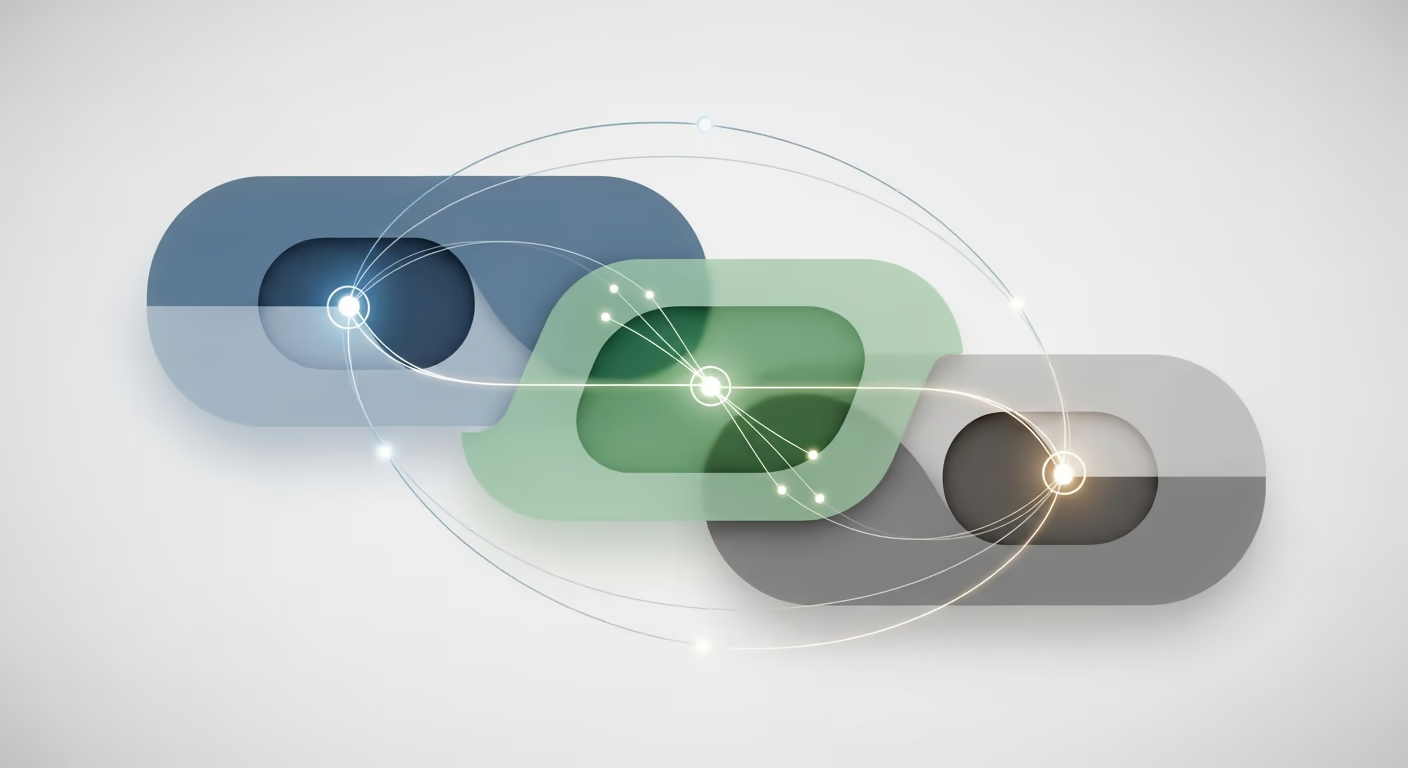
AI transformation isn’t just about smarter models—it’s about operational maturity. The enterprise now runs on a tri-layered stack linking DataOps, ModelOps, and AgentOps into one continuous feedback system.
DataOps ensures clean, governed pipelines. Without it, models learn from noise. It merges DevOps discipline with data stewardship—versioning datasets, automating validation, and enforcing lineage.
ModelOps manages training, deployment, and monitoring. Tools like MLflow or Databricks Model Registry track experiments and automate retraining. Success depends on continuous evaluation—precision, recall, and fairness tracked like uptime metrics.
AgentOps governs autonomous workflows—how agents invoke APIs, coordinate tasks, and learn from results. It defines approval hierarchies, audit logs, and sandboxed environments.
Data feeds models → models inform agents → agents generate new data → data feeds models again. Each cycle improves accuracy and efficiency. Observability platforms close the loop, turning raw activity into insight.
Organizations that connect DataOps, ModelOps, and AgentOps form a living infrastructure—a self-learning enterprise where improvement is built into the workflow itself.

As AI becomes operational, its attack surface expands. Hackers no longer aim only at data—they target cognition itself.
The new threat landscape includes:
Traditional InfoSec protects networks; AI security protects reasoning. Provenance tracking, signed checkpoints, and encrypted embeddings ensure model integrity. Isolation layers prevent one compromised agent from contaminating others.
Regulators are responding. NIST’s AI RMF, ISO 42001, and the EU AI Act define standards for testing and transparency. Enterprises must integrate these into DevSecOps pipelines, treating model validation like code review.
Never trust a model—always verify. Each inference request should authenticate both requester and model version, log decisions, and detect anomalies in real time.
In the agentic era, security is governance. Trust is earned not by perfect accuracy but by provable accountability.
Enterprise AI has no shortage of activity. Pilots are running, copilots are deployed, and agents are moving from controlled testing into live workflows. What many organizations lack is a reliable way to convert that activity into measurable operating results.
Too many programs are organized around a visible question: how much AI can we deploy? It is easy to measure and easy to report, and it says almost nothing about whether the enterprise is improving decisions, reducing cost, or shortening cycle times. The harder question is whether the organization can repeatedly turn AI capabilities into better operating outcomes.
AI programs organize around tools, models, platforms, and use cases. Those are necessary implementation constructs. They are not the right unit for managing value.
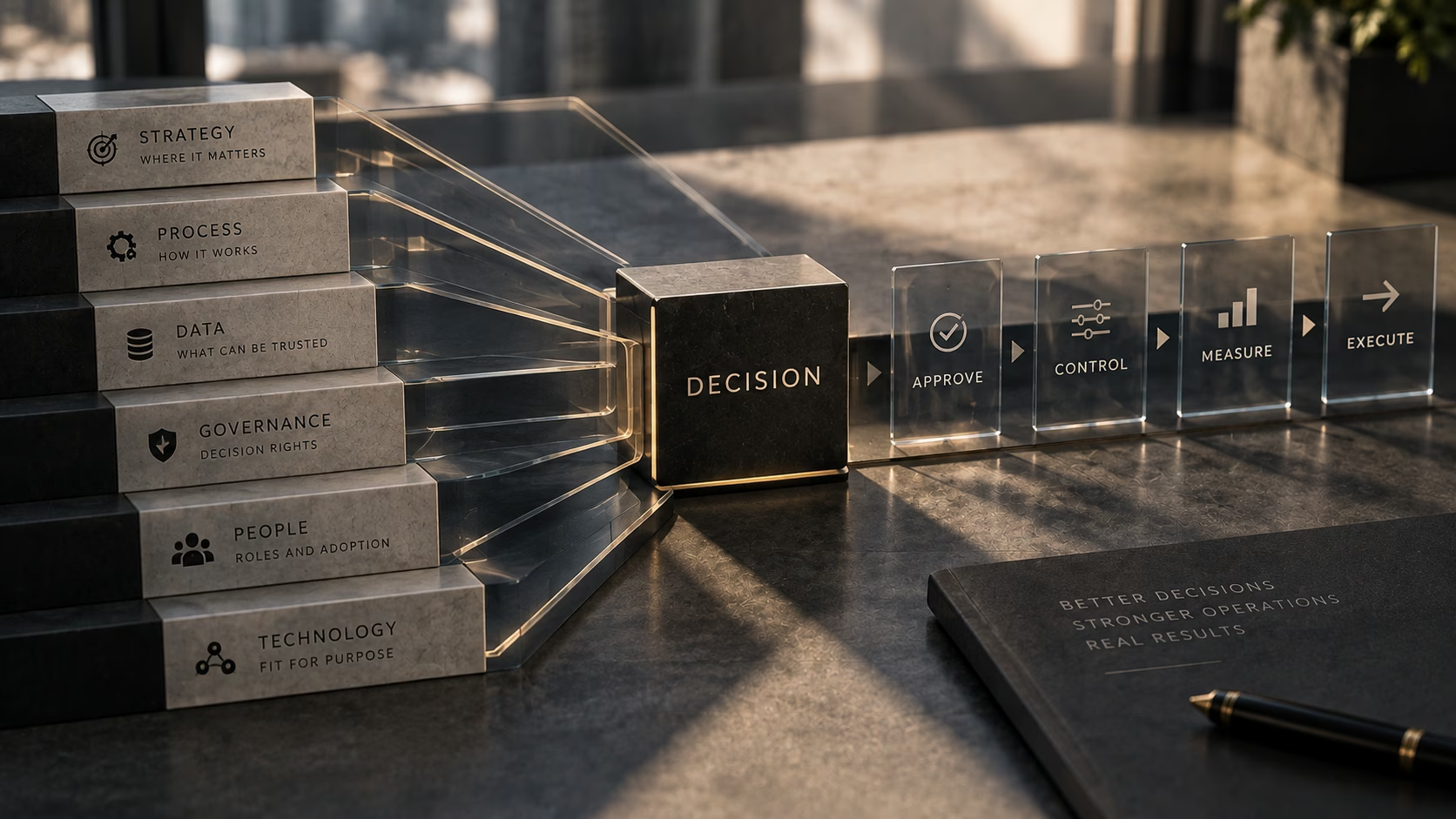
The more useful unit is the decision.
A decision forces leadership to deal with the conditions around the technology. Who owns it? What evidence can be trusted? What authority does that owner have? Where does the decision sit in the workflow? What happens when normal conditions fail? Which actions can technology take without intervention? What requires approval? How will the organization know whether the decision improved?
AI becomes one participant in that system. It may provide an input, recommend an action, or execute a defined task. Ownership and authority still have to be explicit.
An AI capability can perform exactly as designed and still fail to create business value. Better technology does not fix a poorly formed decision, unreliable data, or ambiguous authority. It can move those weaknesses through the organization faster.
The control problem changes when AI moves from recommendation to action. A system that can call tools, trigger a workflow, or execute a transaction creates a different governance requirement from one that produces an answer for a person to review.
Logging remains important. It tells the organization what happened after the event. The harder control sits earlier: was the action authorized when it was about to occur?
That requires defined decision rights, approval thresholds, escalation paths, and rules for what happens when runtime conditions no longer match the conditions under which an action was approved. Traceability after execution does not replace authority at execution.
An organization can maintain a complete audit trail and still have a governance problem. If nobody can explain who had the authority to permit the action, the record documents the gap rather than closing it.
As systems take on more autonomous action, unresolved ownership stops being an inefficiency and becomes an operating exposure.
Enterprise execution rarely fails because every function lacks expertise at once. The problem appears between functions.
Strategy identifies a valuable opportunity, but the process team still has to establish how the work actually happens. Data owners determine which inputs are reliable and whether the proposed outcome can be measured. Governance defines authority and controls in the context of the workflow. People need clarity on roles, adoption, and where human judgment remains necessary. Technology makes its fitment decision after those conditions are understood.
Starting with technology before the workflow is clear can automate unnecessary handoffs and unresolved exceptions. Governance introduced later has to retrofit controls into a design that already assumes authority the system should not have. Teams that proceed before establishing which sources are trusted risk automating decisions using evidence nobody has validated.
Mature execution replaces informal handoffs with defined outputs. A workflow identifies decision points and exceptions. A source-of-truth assessment establishes what the next team can rely on. A decision-rights matrix resolves authority. A fitment decision records why an activation path was selected.
Each artifact has an owner, a downstream consumer, and an acceptance standard. The handoff is complete when the next function has what it needs to proceed, not when another meeting has taken place.
AI should not be the default answer to an AI initiative.
Once the decision, workflow, data, controls, and desired outcome are understood, the technology question gets narrower: what is the lightest viable way to produce the required result?
The answer may be configuration, a workflow change, an integration, conventional automation, or AI. Autonomous approaches belong later in that discussion, once the organization has evidence that the process, data, governance, architecture, security, and day-two operations can support them.
A credible fitment process has to be capable of saying no.
Weak data requires a constrained prototype. Unclear authority requires human approval to remain in the workflow. Poor process fit means redesigning the work before automating it. A fitment assessment that never returns a hard stop is not an assessment.
At enterprise scale, unnecessary complexity becomes an operating cost. Every additional component has to be integrated, secured, governed, monitored, and supported. The technology decision should be judged by its operating result and the burden it adds to the estate, not by how advanced the solution appears.
Getting one use case into production proves very little about the organization's ability to scale.
The first deployment should leave behind more than code and a retrospective. Decision rationale should be retained. Governance patterns that worked should be reusable. Known data constraints should stop being rediscovered. Intake standards, exception handling, fitment logic, and approval patterns should get more precise as the portfolio grows.
A useful lesson has to change something. If a retrospective identifies a recurring failure and nothing changes in a template, control, role definition, gate, or delivery practice, the organization has captured an observation. It has not improved how it executes.
Measurement continues after go-live. The original value hypothesis gets compared with actual results, and variance determines whether the use case is scaled, tuned, paused, or retired. That evidence then affects what gets prioritized next.
This is where scale changes the economics of execution. The organization stops renegotiating questions it has already answered.
If the tenth AI use case requires the same organizational negotiation as the first, the enterprise has scaled activity, not capability.
A mature AI portfolio can answer a short list of questions about any initiative in it:
Those answers indicate execution maturity more reliably than pilot counts, license adoption, or the number of initiatives carrying a production label.
The same standard applies to implementation partners. Strategy has to connect to the mechanics of execution. Technology cannot run ahead of ownership and governance, and governance cannot remain a documentation exercise detached from how decisions are actually made and authorized.
This is the operating problem behind Strategic Systems' new field guide, Answering the Wrong Question Faster. The book codifies a practical point of view around a question that matters more than what AI can do: what has to be true inside the enterprise for AI activity to become governed, measurable execution?
Access to AI technology will keep getting easier. Durable advantage will depend on something harder to replicate: the discipline to decide where AI belongs, establish authority, govern execution, measure the result, and carry what was learned into the next deployment.

When AI becomes the interface, design must account for trust, transparency, and tone. Users need to know why a model responded a certain way. Confidence scores, rationale summaries, and replayable context logs turn black boxes into glass boxes.
Work is also becoming multimodal—text, voice, image, gesture. Designers must choreograph these modes seamlessly while preventing cognitive overload.
Great AI UX feels considerate. It apologizes for errors, offers alternatives, and respects user autonomy. Empathy is not decoration—it’s essential to adoption.
Inclusive design ensures outputs are understandable across cultures and abilities. Accessibility—screen readers, explainability, contrast ratios—is ethical design, not optional compliance.
The best AI isn’t invisible; it’s understandable. Designing for augmented work means making intelligence feel human-centric, transparent, and empowering.

Large language models can read PDFs, interpret logs, and converse with images—but they can’t govern data. Even in the generative era, the foundation of trustworthy intelligence remains clean, secure, well-modeled information.
Platforms like Snowflake and Databricks are evolving into AI operating systems—integrating vector stores, governance, and model serving. The modern data stack isn’t dying; it’s becoming multimodal.
A trustworthy AI architecture has three layers:
Together, they form the backbone of agentic AI—systems that think, act, and learn responsibly.

AI rarely fails because of technical limitations. It fails because it isn’t trusted. Every serious enterprise conversation about AI now starts with one question: Can I trust it?
Trust is now a layer of infrastructure built on observability, guardrails, and human partnership. Observability lets us see how models behave. Guardrails define what models can and cannot do. Human partnership ensures empathy and ethics remain in the loop.
Governance isn’t bureaucracy; it’s scalability. It enables innovation by making risk visible and manageable. The next generation of enterprises will embed governance into the delivery process—policy-as-code, explainability, and human review in every workflow.
Policy defines acceptable boundaries. Transparency measures and monitors outcomes. Human oversight keeps empathy within reach. In the coming years, AI literacy will become as essential as data literacy. Trust will be everyone’s responsibility.

The regulatory tide has arrived. The EU AI Act, U.S. Executive Order 14110, and ISO 42001 mark the shift from voluntary ethics to mandatory accountability.
Governance 1.0 was about awareness; 2.0 is about enforcement. Organizations must inventory every model, classify risk, document datasets, and prove oversight.
EU AI Act: risk tiers from minimal to unacceptable with penalties up to 6% of revenue.
ISO 42001: management system for AI quality and risk.
NIST AI RMF: standard for trustworthy AI development.
Compliance automation—model registries, explainability dashboards, bias testing—transforms governance from a burden to a business enabler.
Transparent enterprises build faster because regulators, partners, and customers trust them. Governance maturity will soon matter as much as cloud maturity once did.

For decades, enterprise infrastructure revolved around two principles: number of users and latency. The goal was always to deliver information to as many people as possible, as quickly as possible. But the rise of AI agents changes everything. These systems don’t wait for humans to act—they act on behalf of humans. They require secure, high-throughput access to data, and they operate across boundaries that traditional architectures were never designed to handle.
The new paradigm is to design around agents and data security, not users. Data has become the gravitational center of architecture, pulling compute, models, and analytics closer to where it lives. That’s why we’re seeing the emergence of what some call the NeoCloud—smaller, AI-optimized infrastructure providers that deliver agility, compliance, and cost efficiency without vendor lock-in. These environments are closer to the enterprise, both physically and operationally.
According to Gartner, by 2027 roughly 60 percent of enterprises will run AI workloads in hybrid or on-prem environments for reasons of performance and data protection. NeoClouds and vClusters enable companies to keep sensitive workloads local while still taking advantage of large-scale compute when needed.
Large language models (LLMs) thrive on unstructured, messy data—but they still depend on trustworthy, well-governed sources. Platforms like Snowflake and Databricks aren’t disappearing; they’re transforming, embedding vector search, semantic indexing, and model serving directly into the warehouse. The future NeoCloud merges data gravity with AI proximity, where governance, structure, and unstructured insight coexist.
The old Bronze/Silver/Gold hierarchy was designed for ingestion and analytics, not understanding. The next generation replaces those tiers with a Unified Knowledge Layer—a governed, semantic repository that allows both humans and machines to access meaning, not just data. Governance, lineage, and embeddings converge; context becomes as important as content.
We’re entering a post-lake, post-API world—where intelligent agents act wherever data lives, anchored by evolving warehouses and unified knowledge layers that bridge structure and reasoning.